

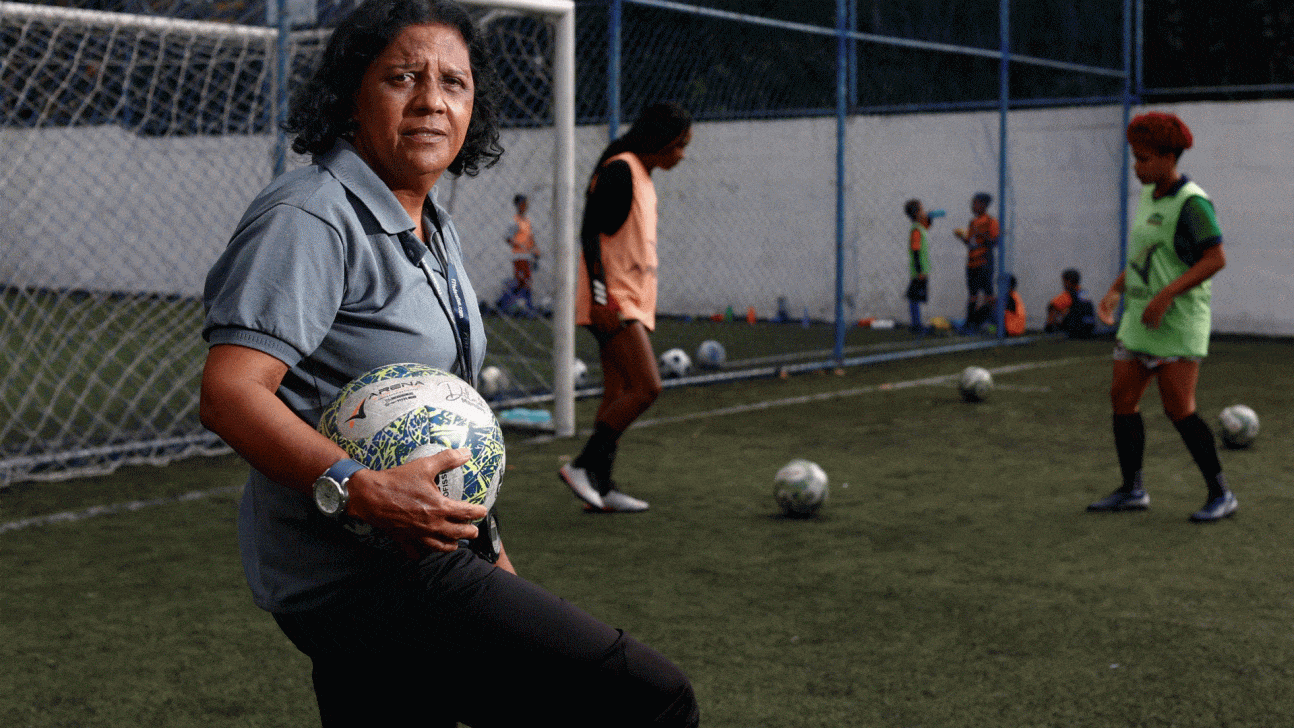
Dilma Mendes doesn’t know how many times she was arrested when she was young. What did she do wrong? Going to Brazil to play sports.
Even though the country is known for “the beautiful game,” women were not allowed to play until 1979.
Mendes talked about how hard she worked to become a football player before the Women’s World Cup, which starts next week in Australia and New Zealand. Brazil will be playing in the tournament.
In the 1970s, when she was a girl, she gave ice cream to the boys she played with in Camacari, which is in the poor northeast of Brazil. In turn, the boys told her when police were coming to catch girls breaking the law.
She used to dig a hole next to the field so she could hide from the police until they left. Then she would crawl out and play soccer with her male friends.
When they let her, which didn’t happen all the time.
Sometimes, Mendes’s safety plans didn’t work, and she was taken to a police station.
“When I was a child, I thought the police stopped people who did something wrong, and I didn’t think I was doing anything wrong,” Mendes, who is now 59, told AFP.
“The police were nice to me, but some of them told me I couldn’t play football because it was for men.”
In 1941, Getulio Vargas, who was president at the time, signed a law that said girls and women couldn’t play football. At the time, many people thought that sports could make it harder for women to have children.
The order said that women couldn’t do “sports incompatible with the conditions of their nature.”
There were no specific punishments given, so it was up to each police officer to decide how to deal with criminals.
Women were also not allowed to play football in Britain, Germany, and France, but Brazil’s ban was the only one that was written into law.
It was still there until 1979.
Even though many women kept playing, like Mendes, the 38-year ban slowed the sport’s growth among Brazilian women at a time when their male peers won three of their five World Cups.
Played against for
The ban came at a time when people were more socially strict and women were seen as “maternal figures” who belonged in the home. Brazilian sports expert Silvana Goellner said that women’s appearance on a sports field went against this idea.
Women who broke the order have never been sent to jail, but they would be held and only let go after being questioned.
Goellner, who co-wrote a book about the subject, said that many people “never stopped playing” even though they were afraid of being arrested. “They came up with ways to get around the law.”
Some played as guys, while others did it at night or in places no one could see. When they were caught, they ran in different ways to confuse the people who were after them.
But many of them couldn’t get away from a much closer reckoning: their families.
Mendes remembers sitting at the police station and hoping that her father, who backed her love, would come get her.
If it were her mother, she would get in trouble for practicing a “men’s sport,” according to the youngest of seven children, five of whom are boys.
“It was hard to get beat up by your mother and brothers when you got home, and then you had to play again the next day,” Mendes said.
“That cruel process made a lot of my friends quit football.”
But she didn’t give up. She had a humble career in futsal, a version of football played on a small court, often indoors, and in professional football when it was officially opened to women in Brazil in 1983, in response to growing calls for equal rights.
Didn’t stand a chance.
After Mendes stopped playing in 1995, he became a teacher and helped find Formiga, who was a famous defender for the Brazil women’s team.
She also led Brazil’s women to win at the 2019 World Cup for seven-a-side soccer.
Mendes said that the “cruel” ban meant that Brazil had “great players” who never got a chance to play. This has led to a very shaky history of women’s football in the South American country.
Things have changed, though, and now the “Selecao” is getting ready for their ninth Women’s World Cup.
They will lose under the leadership of Marta, the team’s captain and an experienced player who has scored more World Cup goals (17) than any other player, male or female.
Brazil’s best performance at the event, which was first held in 1991, was in 2007, when Germany beat them in the final.