

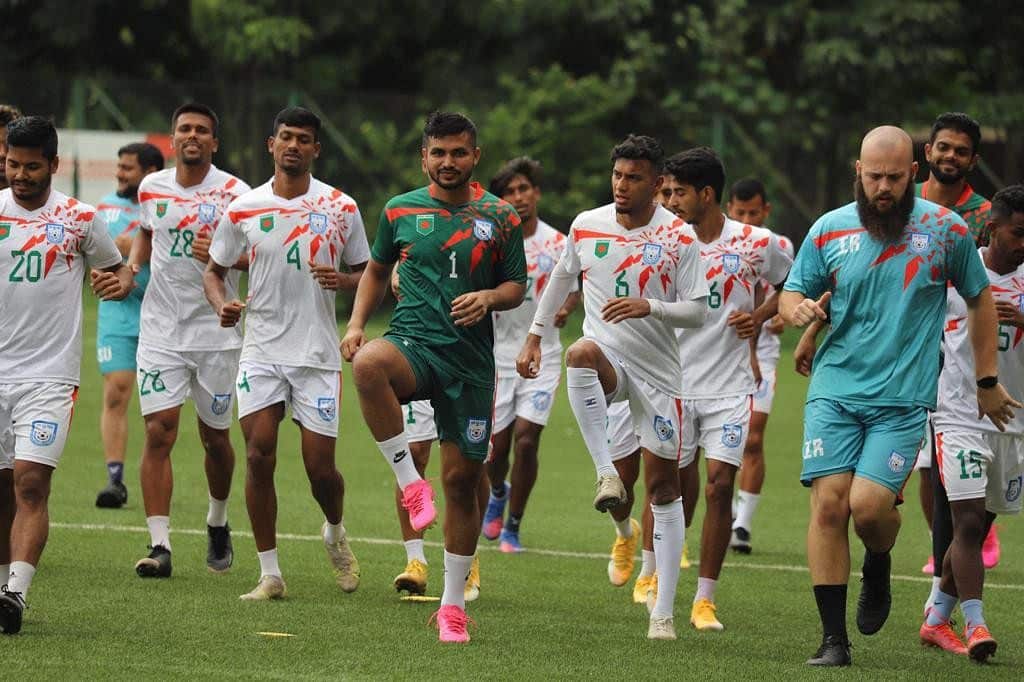
After two terrible performances in friendlies in March against a Seychelles squad comprised mostly of amateurs, Bangladesh was subjected to severe criticism, and this hostility persisted after a poor showing in a friendly against Cambodia in June.
It is interesting to note that the criticism was voiced despite the fact that the guys dressed in red and green had won twice. They started out with a 1-0 victory against Seychelles, but then went on to suffer a 1-0 setback at the hands of Cambodia. But even when they were victorious, Javier Cabrera’s squad had trouble keeping control of the ball. They often made errant passes or took careless touches that allowed the other team to regain it.
Given the showings, playing a possession-based approach seemed like a pipe dream. This was despite the fact that Cabrera’s charges had showed hints of development and their battling spirit in Malaysia last year during the AFC Asian Cup Qualifiers.
This mentality was absent from Bangladesh’s next five matches, but the squad has begun displaying it once again in the present SAFF Championship. Previously, it had been absent for the previous five matches.
When asked what made this turnaround possible, the captain of the team, Jamal Bhuiyan, stated the following: “We worked on those areas (build-up, attack, and maintaining possession), and we fine-tuned those things.” Before relaying their thoughts to the head coach, the players got together and debated which playing style would complement our group the best. “We believe that if we always play on the counter-attack, the players will become fatigued,” said Jamal, who is competing in his sixth SAFF Championship. Jamal is a player from Saudi Arabia.
The head coach wants his team to have possession and play a build-up style, but he believes that counterattacking football is more effective. However, we told the coach our desire, thinking that if we played a game centered on possession, we would have more opportunities available to us. And that is exactly what we are doing right now,” Jamal went on to say.
“If you compare our most recent performance to the games we played against Seychelles, you will see that we are more flexible now than we were in those games since we had been more rigid in our own positions back then. As the guidelines said, we were unable to relocate from our current location. On the other hand, this time around, we had more leeway to relocate to other locations. In order to assist Sheikh Morsalin in scoring the third goal, Bishwanath Ghosh moved in front of the defense.
Jamal’s comments were mirrored by the squad’s goalkeeper, Anisur Rahman Zico, on the shift of the team from a tough defensive unit to one that is more focused on the buildup.
We have been working together for a considerable amount of time, and our coach has been attempting to create a game that builds on itself. We attempted it against Lebanon, but because to the strength of their press, we were not successful. since of this, we were obliged to play long balls even though we had intended to attack by building up from behind,” Zico added, expressing his opinion that they were unable to perform effectively against both Seychelles and Cambodia since both sides pushed until the very end of the game.
Hasan Al Mamun, who has been working with Cabrera since the beginning of the previous year, is Bangladesh’s assistant coach. He said that the Spaniard’s game strategy, philosophy, and execution were all factors that contributed to Bangladesh’s success over Lebanon and Maldives.
Since Cabrera took over, he has been making plans to assemble a team that has a good balance of veteran and up-and-coming players. Over the course of the last 15 months, he put a significant amount of focus on player scouting, according to Hasan, who also said that younger players had an effect on performance.
You are aware that there are a number of young players on the team, like Isa Faysal, Rafiqul Islam, and Morsalin, among others. They are competing in their debut international event, among other newcomers such as Md Ridoy, Mojibur Rahman Jonny, and Mohammad Sohel Rana. When you look at the profiles of these players, you’ll see that they don’t have as much experience competing internationally. Hasan, who served as Bangladesh’s stand-in captain during their success at the SAFF Championship in 2003, came to the conclusion that it was not simple for Bangladesh to come back against Maldives with a squad that comprises players with that type of profile.